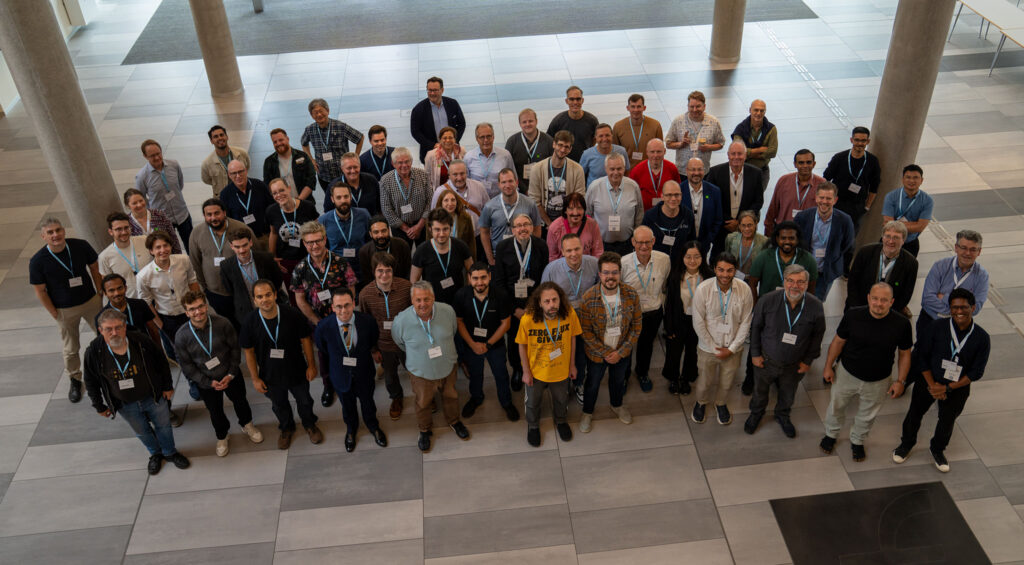
After decades in the shadows of digital computing, analog computing is making a remarkable comeback and on June 11–12, 2026, that comeback had its first dedicated conference. The Analog Computing Days 2026 (ACD’26), held at the Frankfurt School of Finance & Management, brought together researchers, engineers, educators, policy makers, and industry representatives for two days of presentations, a poster session, and a hackathon. The Design Cybernetics Group was there, presenting two ongoing projects.
For many of the participants, the amount, the quality, as well as the and breadth and interdisciplinary variety of analog computing research was surprising. The program ranged across integrated circuit design, mathematical modeling, biological computing, neuromorphic systems, AI acceleration, chaos theory, and the philosophy of computation — a reminder that analog computing is not a single technology but a paradigm with ramifications across many fields. Notably, the conference also had a policy dimension: the opening address on the second day was delivered by Kristina Sinemus, Minister for Digitalisation and Innovation of the State of Hesse, signaling that analog computing is increasingly on the radar of public institutions, not just research labs.
The meeting left no doubt that analog computing has much to contribute the future of sustainable and unconventional computing, sparking numerous conversations that are pointing toward future collaborations and to what will, hopefully, become an annual gathering. Our lab contributed two posters at to teh event during the Thursday evening poster session, held alongside the hackathon. Tom presented two posters on behalf of group members Xue Chao and Wang Yuxuan, and our collaborator of The Hong Kong Polytechnic University Clifford Choy.
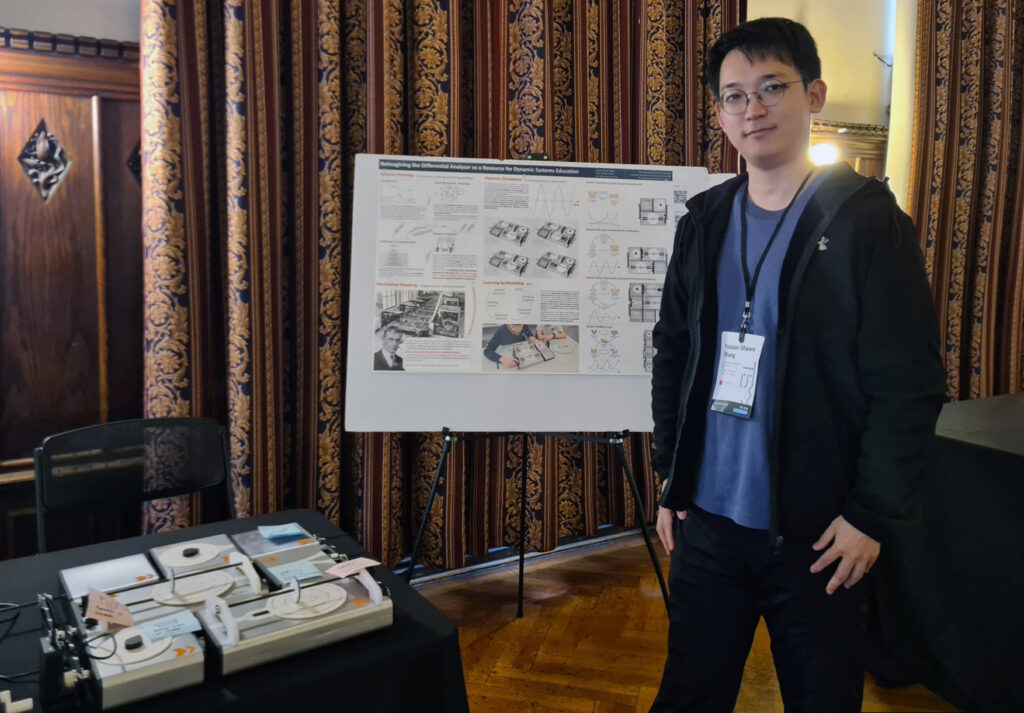
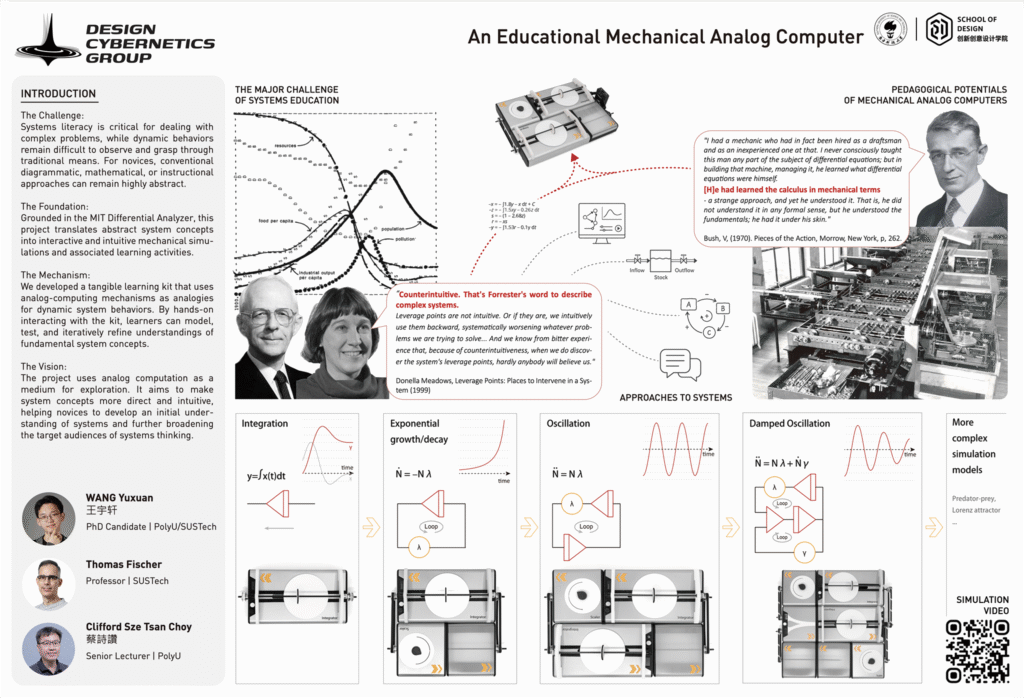
The first poster presented Wang Yuxuan‘s ongoing PhD research: a tangible, modular learning kit that allows novice learners to model and explore dynamic systems without prior knowledge of calculus. Drawing inspiration from the MIT Differential Analyzer — the pioneering mechanical analog computer developed by Vannevar Bush around 1930 — the kit reimagines the disk-wheel integrator as a hands-on pedagogical tool. Learners physically assemble and reconfigure computing modules connected by timing belts, directly observing emergent system behaviors such as exponential growth, oscillation, damping, and predator-prey dynamics. This project has been presented previously at RSD14 in Toronto and, most recently, at TEI ’26 in Chicago. The response at ACD’26 was enthusiastic — and the analog computing community, with its particular sensitivity to the educational and historical dimensions of the field, proved to be an especially receptive audience.
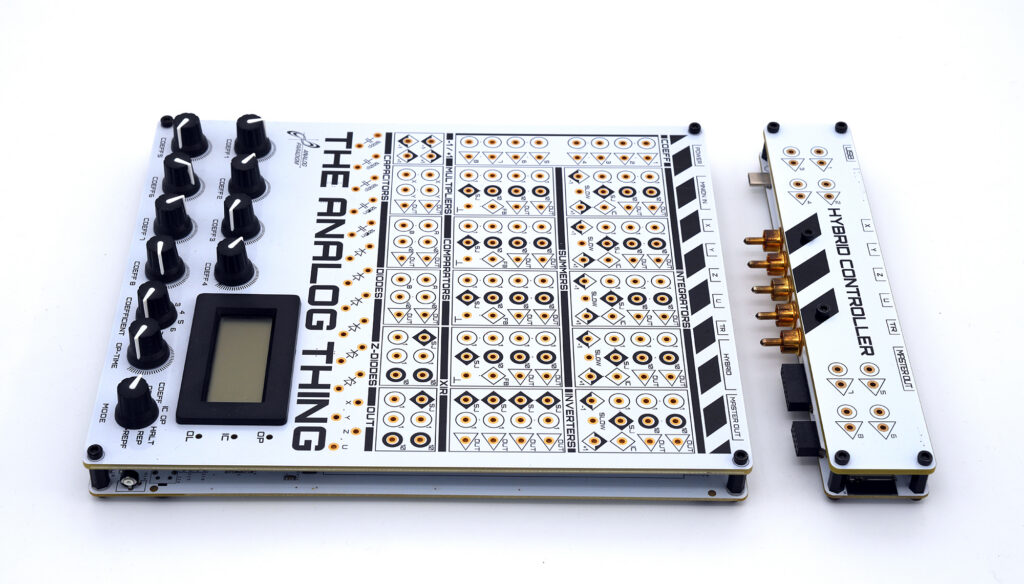
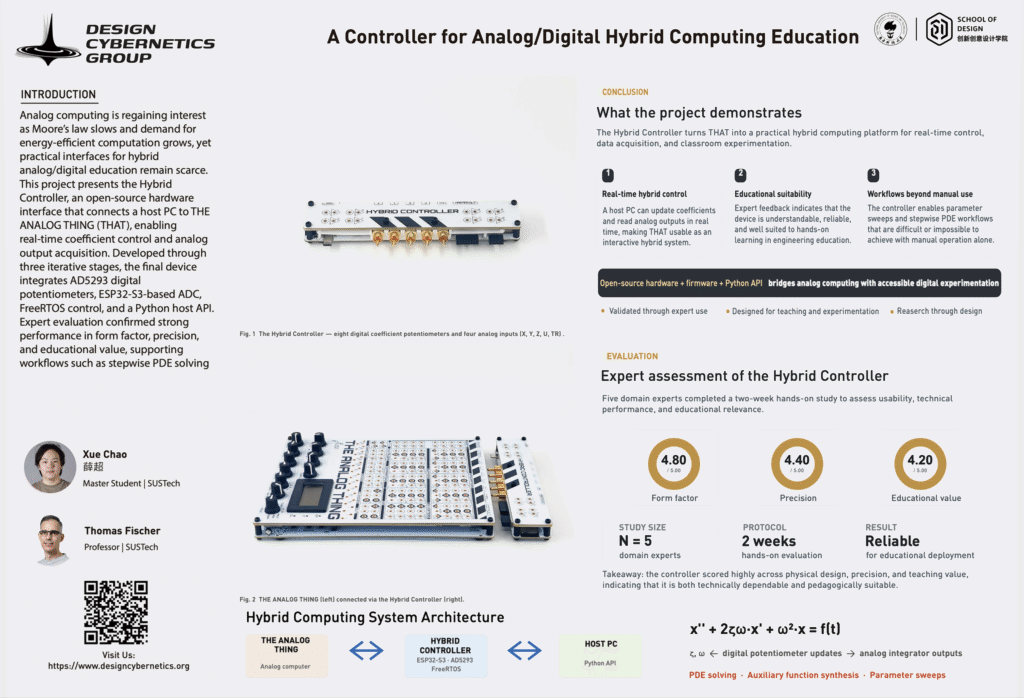
The second poster presented Xuechao‘s Master’s research: a hybrid analog-digital controller designed for THE ANALOG THING (THAT). The controller allows users to operate THAT through an intuitive digital interface while feeding analog outputs back into a Rhino/Grasshopper parametric design environment — bridging the worlds of analog computation and contemporary architectural design software. Earlier presentations of this work appeared at eCAADe 2025 in Ankara and, in its initial form, in a 2024 post on this blog. Again, the response at ACD’26 was very positive.
The highlight of the conference was the hackathon. More than a technical exercise, it functioned as a space for the analog computing community to work together informally, share feedback, and think out loud about where the field is heading. Tom used the opportunity to gather detailed input from other participants on the further development of Xuechao‘s hybrid controller — conversations that will directly inform the next phase of the project.