On September 4th, 2025, Xue Chao and Bao Boyu, Master’s students in the Design Cybernetics Group, were invited by the eCAADe organizing committee to present their paper, “Analog-Digital Hybrid Parametric Design Modeling” at the eCAADe 2025 Conference in Ankara, Turkey. The paper was co-authored by Thomas Fischer.


In architectural design, mainstream computational tools rely almost entirely on digital technology. Less widely known is the significant role analog computing played before digital methods became ubiquitous. This research reintroduces the analog computing paradigm—and specifically, analog-digital hybrid computing—to architectural parametric design.
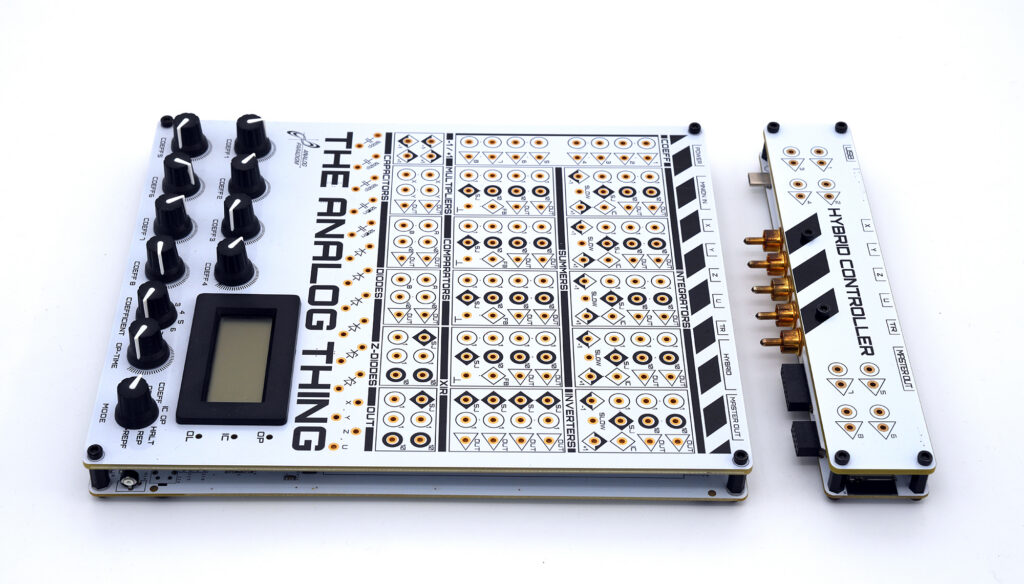
The study is based on an analog-digital hybrid computing controller currently under development by Xue Chao in the Design Cybernetics Group laboratory. Applying this controller aims to reconnect architectural design modeling with its analog computational roots. The conference paper and presentation validated the feasibility of this approach by demonstrating the hybrid computing of catenary curves and cantilever beams within the Rhino/Grasshopper parametric design environment.

The paper details the use of the hybrid controller as an intuitive interface to operate THE ANALOG THING (THAT), while digitally acquiring its analog outputs. The acquired results dynamically adjust the values of digital potentiometers on the controller, which are then fed back to THAT., completing the hybrid control loop. Simultaneously, the digital data from THAT is visualized on-screen for interactive design exploration using a custom Rhino/Grasshopper plugin.


This hybrid methodology reduces the operational complexity of analog computers while avoiding the intricate calculations of purely digital systems. The team successfully implemented two architectural applications of this approach: catenary curves and bending beams.
Future work will focus on improving the hybrid controller’s performance – enhancing data transmission speed and computational precision to support more complex architectural design scenarios. The team also anticipates expanding the application scope of this modular hybrid parametric design modeling framework.
Reference